Playback starts YouTube’s embedded player (privacy-enhanced mode).
How to Write Funny Dialogue (What I Learned Writing Storming)
ChannelK.M. WeilandDescription from the creator
helpingwritersbecomeauthors.com
kmweiland.com
Historical and speculative novelist K.M. Weiland offers tips and essays about the writing life to help other writers understand the ins and outs of the craft and the psychology behind the inspiration.
This week’s video Shows you the two important (but often overlooked) ingredients in figuring out how to write funny dialogue your readers will love.
Video Transcript:
Today, I’m excited to welcome you to the first installment in a month-long series featuring important writing lessons that I learned in the past few years while writing my historical/dieselpunk mashup Storming, which will release December 4th. To start off with, we’re going to talk about how to write funny dialogue. Funny dialogue can show up in all kinds of stories, whether you’re writing an outright comedy or, like me in Storming, something that’s not a comedy, but that has a lot of adventurous, light-hearted moments—or even a downright tragedy, in which the humor functions as irony or a contrast against the darkness of the story.
The trouble, as anyone who has ever deliberately tried to write humor can tell you, is that figuring out how to write funny dialogue on purpose is hard. Partly this is because of the subjective nature of humor, but mostly it’s because truly funny dialogue is not based on one-liners. In other words, as I was reminded and time again while writing the banter between my cocky barnstorming pilot and the mysterious non-English-speaking woman who falls out of the sky, the creation of funny dialogue relies on two very important—but often overlooked—ingredients.
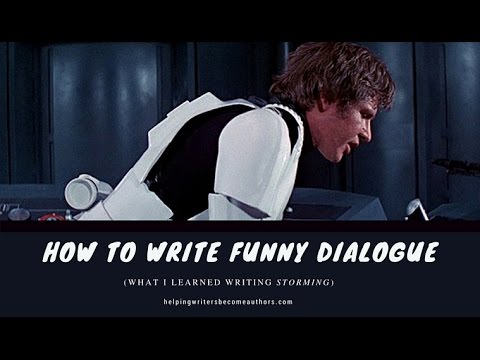
The first of these ingredients is context. For me, the holy grail of great dialogue is Star Wars. But Han Solo’s classic line about “boring conversation anyway” is only funny in its context of his bumbling through an impersonation of a stormtrooper trying to reassure a superior officer. In short, you have to start with a setting and a situation that create the kind of conflict that sets up the opportunities for humor. Second ingredient is character. Let’s face it: some people are funnier than others. Same goes for characters. The best lines are always going to arise out of the heart of the character—whether he’s sarcastic, impulsive, mean, dumb. Readers are always going to be delighted by the kind of funny dialogue that hasn’t been forced into the character’s mouth, but rather arises naturally out of his personality.
kmweiland.com
Historical and speculative novelist K.M. Weiland offers tips and essays about the writing life to help other writers understand the ins and outs of the craft and the psychology behind the inspiration.
This week’s video Shows you the two important (but often overlooked) ingredients in figuring out how to write funny dialogue your readers will love.
Video Transcript:
Today, I’m excited to welcome you to the first installment in a month-long series featuring important writing lessons that I learned in the past few years while writing my historical/dieselpunk mashup Storming, which will release December 4th. To start off with, we’re going to talk about how to write funny dialogue. Funny dialogue can show up in all kinds of stories, whether you’re writing an outright comedy or, like me in Storming, something that’s not a comedy, but that has a lot of adventurous, light-hearted moments—or even a downright tragedy, in which the humor functions as irony or a contrast against the darkness of the story.
The trouble, as anyone who has ever deliberately tried to write humor can tell you, is that figuring out how to write funny dialogue on purpose is hard. Partly this is because of the subjective nature of humor, but mostly it’s because truly funny dialogue is not based on one-liners. In other words, as I was reminded and time again while writing the banter between my cocky barnstorming pilot and the mysterious non-English-speaking woman who falls out of the sky, the creation of funny dialogue relies on two very important—but often overlooked—ingredients.
The first of these ingredients is context. For me, the holy grail of great dialogue is Star Wars. But Han Solo’s classic line about “boring conversation anyway” is only funny in its context of his bumbling through an impersonation of a stormtrooper trying to reassure a superior officer. In short, you have to start with a setting and a situation that create the kind of conflict that sets up the opportunities for humor. Second ingredient is character. Let’s face it: some people are funnier than others. Same goes for characters. The best lines are always going to arise out of the heart of the character—whether he’s sarcastic, impulsive, mean, dumb. Readers are always going to be delighted by the kind of funny dialogue that hasn’t been forced into the character’s mouth, but rather arises naturally out of his personality.
About this tutorial
K.M. Weiland published this 2:45 video tutorial on November 2, 2016. It has been watched 36,924 times on YouTube.
- Channel
- K.M. Weiland
- Category
- Education
- Duration
- 2:45
- Published
- November 2, 2016
- Views
- 36,924
- Likes
- 752
Tags
Share
This tutorial in other languages
- FRComment écrire drôle Dialogue (Ce que j'ai appris l'écriture Storming)
- ESCómo escribir el diálogo divertido (Lo que aprendí de Escritura de asalto)
- PTComo escrever o diálogo engraçado (O que eu aprendi Escrita Assalto)
- ITCome scrivere divertente Dialogue (Che cosa ho imparato scrittura Storming)
- DEWie Lustige Dialog schreiben (was ich Writing Storming gelernt)
- NLHoe schrijf Funny Dialogue (wat ik geleerd Schrijven Storming)
- RUКак написать смешной диалог (Что я узнал Дать штурм)
- PLJak napisać śmieszny dialog (What I Learned Pisanie Storming)
- JAおかしい対話を書く方法(私が執筆ストーミングを学びました)
- ARكيفية كتابة حوار مضحك (ما تعلمت الكتابة اقتحام)
- HIअजीब बात है वार्ता कैसे लिखें (क्या मैं लेखन तूफान सीखा)
- IDCara Menulis Lucu Dialog (Apa yang saya Learned Menulis Storming)