Playback starts YouTube’s embedded player (privacy-enhanced mode).
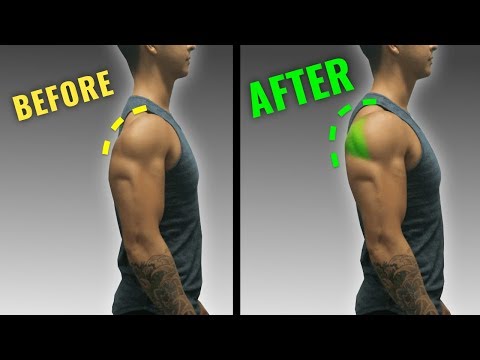
How To Grow Your Rear Delts FAST (4 Key Exercises You’re Not Doing)
ChannelJeremy EthierIn brief
You’ll learn four targeted exercises to effectively develop your rear delts, avoiding common mistakes that limit growth. These movements—barbell high row, dumbbell incline row, lying face pull, and rear delt cable pull—prioritize proper form to maximize rear delt engagement and minimize trap or lat dominance. Ideal for anyone looking to balance shoulder development beyond standard routines.
Questions & answers
What grip width is used for the barbell high row?
Wide enough so your arms are about 45° out from your sides when standing.
Why does the lying face pull reduce trap dominance?
The creator notes upper traps are more active in upright positions, so lying down shifts focus to rear delts.
Description from the creator
The first exercise is going to be the barbell high row, which when performed correctly, will effectively hit the rear delts with some involvement of the biceps as well. Now to perform it, grab a barbell with a wide grip such that your arms are about 45 degrees out from your sides when standing. Next, set up how you would for a normal barbell row by slightly bending the knees and hinging at the hips until your back is almost parallel to the ground. Now at the starting position, think about pushing your fists down into the floor in order to protract your shoulder blades, as this will help prevent your traps from taking over the movement.
The next exercise, the dumbbell incline row, is another heavy movement that will effectively hit the rear delts. This rear delt exercise successfully incorporates the many movement functions of the rear delts with additional external rotation to emphasize the rear delts even more. Now to perform it, first set up a bench to an incline of roughly 30 degrees. Next, grab a pair of dumbbells in each hand and then lift the dumbbells up with your elbows angled out to your sides rather than tucked in, as anatomical analyses indicate that this puts the rear delts in a stronger position and prevents the lats from taking over. Now as you pull, you’ll want to externally rotate your shoulder by turning your wrists outwards during each rep. Hold the top position briefly while fully contracting your rear delts before coming back down.
The third exercise for the rear delts is going to be the lying face pull to now hit the rear delts with lighter weight and higher reps. Now although most of us know that the traditional standing or kneeling rope face pull is a great exercise for the rotator cuff and rear delts, I find that for a lot of people the traps, especially the upper traps, tend to take over the movement. However, by knowing that the upper traps are more active during upright exercises since they work as a postural muscle, we can modify the face pull by performing it laying on the ground instead. And to perform it, you simply perform a regular face pull but laying on your back instead.
This last exercise of the rear delt workout, the rear delt cable pull, is another great way to hit the rear delts with lighter weight and higher reps and is especially effective if you struggle with your neck, traps, or mid-back taking over on other rear delt exercises. So to properly perform it, what you’ll want to do is set up a cable to just higher than shoulder height. Grab the ball of the cable with no handle, and then simply bring your slightly bent arm down and back behind your body at an angle at around 45 degrees away from your side. Keep your elbow locked throughout each rep and as you come down, externally rotate your shoulder by twisting your arm and hand outwards as you bring the cable down.
I hope you were able to see that in order to grow your muscles in the fastest way possible, you need to not only carefully consider what exercises you perform but also how you perform them. And within my Built With Science programs, we not only put careful thought and research into each and every exercise that’s included in your routine, but we’ve also created in-depth tutorials for each exercise so that you can execute them optimally and build muscle as fast as possible.
To join today, simply head on over and take the starting point analysis quiz to discover the best program for you: builtwithscience.com/bws-free-fitness-quiz/gend…
LINK TO WRIST STRAPS:
amzn.to/2YhLtWs
*The above link is an affiliate link meaning I will receive a small portion of the sale. Thank you in advance!
GRAPHICS:
Vector art from Vecteezy.com
MUSIC:
soundcloud.com/lakeyinspired
STUDIES:
STABILIZERS OF SHOULDER JOINT
ncbi.nlm.nih.gov/pubmed/11222932
EGM ANALYSIS DELTOID STRENGTH TRAINING EXERCISES
bisp-surf.de/Record/PU201312008451
DELTOID MUSCLE CHARACTERISTICS
ncbi.nlm.nih.gov/pubmed/20157873?source=post_pa…
ACE RESEARCH - TOP SHOULDER EXERCISES
acefitness.org/education-and-resources/professi…
BACK ANATOMY
ncbi.nlm.nih.gov/books/NBK448120/
REHABILITATION OF SCAPULAR MUSCLES
ncbi.nlm.nih.gov/pubmed/17606671
About this tutorial
Jeremy Ethier published this 9:38 video tutorial on October 27, 2019. It has been watched 5,434,567 times on YouTube.
- Channel
- Jeremy Ethier
- Category
- People & Blogs
- Duration
- 9:38
- Published
- October 27, 2019
- Views
- 5,434,567
- Likes
- 112,236
Tags
Share
This tutorial in other languages
- FRComment faire croître votre arrière Delts FAST (4 Exercices clés Vous ne faites pas)
- ESCómo hacer crecer su posterior Delts RÁPIDO (4 ejercicios clave usted no está haciendo)
- PTComo crescer seu posterior de ombros RÁPIDO (4 Exercícios chave você não está fazendo)
- ITCome crescere il tuo Delts posteriore VELOCE (4 esercizi chiave che non stai facendo)
- DEWie man schnell Ihr Rück Delts wachsen (4 Key Übungen Sie sind nicht zu tun)
- NLHoe je je achter Delts groeien snel (4 Key Oefeningen U bent niet te doen)
- RUКак Вырастить Ваш задний Delts БЫСТРО (4 Основных упражнений вы не делаете)
- PLJak Grow Your delts tyłu FAST (4 Kluczowe Ćwiczenia Ty nie robić)
- JAどのくらいの速あなたのリアDELTSを成長させる(あなたがやっていないしている4つのキー演習)
- ARكيف ينمو الخلفية Delts ديك FAST (4 تمارين الرئيسية أنك لا تفعل)
- HIकैसे आपका रियर Delts फास्ट बढ़ो करने के लिए (4 कुंजी व्यायाम आप नहीं कर रहे हैं)
- IDBagaimana Untuk Grow Rear Delts Anda CEPAT (4 Latihan Key Kau Tidak Melakukan)