Playback starts YouTube’s embedded player (privacy-enhanced mode).
How To: Airlift & Geyser Well Pump Prototype Explorations and Test Data
ChannelMtnLakeLabsDescription from the creator
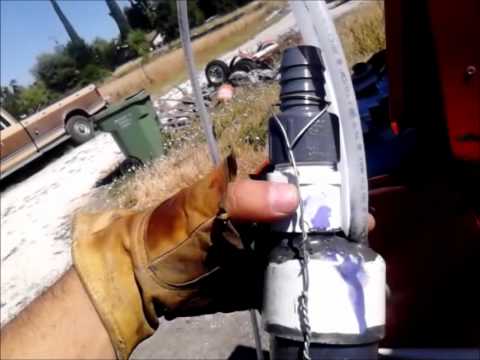
This is a compilation of little videos made while exploring a variety of airlift, geyser, and airlift-geyser pump designs for my well. At first, I began with porting air from a compressor into my 1" poly pipe from the previous pump at distances of 4" to 12" from the bottom (which is best with a 45 degree cut) of an airlift pump (3/8" feed line into 1" riser). Next, I moved to a hybrid airlift-geyser pump which used a 2" outer casing, 1" interior pipe, and the 1" riser. This was initially fed air by a 1/4" line. Then a 3/8" line. Finally, in the last part of the video (and poorly introduced), I moved to a revised and more efficient design as just an airlift pump (no geyser chamber). This cut my previous geyser pump down by a few feet and capped the bottom of the previous design with a 2" end cap, whereby I added a 1 foot extension and check valve with screen. What resulted was a 2" air chamber surrounding the 1" interior pipe. The 1" interior pipe was drilled with a smaller number of injection holes varying from 1/8" to 1/4" in the top few inches of the interior pipe, fewer small holes in the mid-section and incrementally -- in circular pattern around the pipe. Near the bottom of the chamber, many small and large air holes were drilled at 1/8" to 3/8". This acts to distribute air in the riser pipe more evenly -- making the pump more efficient -- and it also lightens the water column with air bubble injection prior to feeding in the bulk of the air. The check valve at the bottom of the pump dramatically increases efficiency by not allowing air escape and feeding that only up the riser pipe.
Video notes:
Throughout the video, I made a couple errors in statement:
1) In the water geyser pumping from the well, I stated the flow-rate at "1 gallon per second" repeatedly. This was a brain fart. That was more like 1/4 to 1/8th gallon per second, not 60 gallons per minute but 7 to 15 gpm. Earlier tests of just the riser pipe with a single port air injection resulted in a piddley 1 to 2 gpm with ample air wasted out the bottom of the pipe and into the well casing (which was reason for addition of the check valve).
2) I stated the riser poly pipe was 1" (It is), but that the interior pipe was 3/4". It is 1".
3) One or two other brief blurbs where I called something "back pressure" or having no pressure. That is technically wrong. Brain fart.
* These were prototype experiments in dimensioning and design using PVC parts, epoxy, and the whole thing was pretty hokey & quick in construction for rapidity of exploration. For long-term use, when the design is finalized, it is best to switch over to welded steel pipes (or copper, or threaded PVC parts) for system reliability -- as glued joints under such vibrational stresses from the bubbling will eventually yield to shear, tension, and compression stresses with age, resulting in pump failure and great inconvenience in fishing parts out of the well. Here, I used a lot of JB Weld and also hot melt glue in assembly of the parts to fit everything within the narrow interior of a 3" well casing. Where larger diameter well casings are available, you will find that wider diameters to the pump and deeper submergence yield much greater flowrates on minimal air.
* Though an air compressor is used herein, at the time of this video's posting, I had ordered a blower. The reason for that is because any air compressor wastes a huge amount of wattage in pumping and compressing air to the regulator pressure setting. You wind up with lower volume (9.8 to 11 CFM) of high pressure air, such as in this video...all while burning kilowatts. However, a transition to a pond / deep water air pump uses much lower wattage to do the same work. It gives high volume airflow at low pressure with no energy wasted on compression. Once that air is in the chamber and ported into the water, the least bit of energy applied uses an air bubble's natural expansion and buoyant force in water to perform a piston action along the riser pipe. So, now you are harnessing the power of nature to water pump -- yielding cleaner, aerated water, simpler & more reliable mechanical systems, and more water volume moved with less energy applied than conventional pumps. As far as energy bills go, the compressor running in the videos operating at about 1 minute every 4 to 5 minutes to repressurize the tank (at its lowest setting delivering about 500 gallons per day) was costing about $90/mos in power. Prior AC well pumps cost about $40 to $50/ mos, depending upon usage. DC suction or submersible pumps cost about $10 to $30/mos, but more so in maintenance and replacement costs due to brushed motor breakdowns and vane maintenance. Estimate on blower energy costs is about $10 to $30/mos depending upon usage.
MtnLakeLabs.com
Video notes:
Throughout the video, I made a couple errors in statement:
1) In the water geyser pumping from the well, I stated the flow-rate at "1 gallon per second" repeatedly. This was a brain fart. That was more like 1/4 to 1/8th gallon per second, not 60 gallons per minute but 7 to 15 gpm. Earlier tests of just the riser pipe with a single port air injection resulted in a piddley 1 to 2 gpm with ample air wasted out the bottom of the pipe and into the well casing (which was reason for addition of the check valve).
2) I stated the riser poly pipe was 1" (It is), but that the interior pipe was 3/4". It is 1".
3) One or two other brief blurbs where I called something "back pressure" or having no pressure. That is technically wrong. Brain fart.
* These were prototype experiments in dimensioning and design using PVC parts, epoxy, and the whole thing was pretty hokey & quick in construction for rapidity of exploration. For long-term use, when the design is finalized, it is best to switch over to welded steel pipes (or copper, or threaded PVC parts) for system reliability -- as glued joints under such vibrational stresses from the bubbling will eventually yield to shear, tension, and compression stresses with age, resulting in pump failure and great inconvenience in fishing parts out of the well. Here, I used a lot of JB Weld and also hot melt glue in assembly of the parts to fit everything within the narrow interior of a 3" well casing. Where larger diameter well casings are available, you will find that wider diameters to the pump and deeper submergence yield much greater flowrates on minimal air.
* Though an air compressor is used herein, at the time of this video's posting, I had ordered a blower. The reason for that is because any air compressor wastes a huge amount of wattage in pumping and compressing air to the regulator pressure setting. You wind up with lower volume (9.8 to 11 CFM) of high pressure air, such as in this video...all while burning kilowatts. However, a transition to a pond / deep water air pump uses much lower wattage to do the same work. It gives high volume airflow at low pressure with no energy wasted on compression. Once that air is in the chamber and ported into the water, the least bit of energy applied uses an air bubble's natural expansion and buoyant force in water to perform a piston action along the riser pipe. So, now you are harnessing the power of nature to water pump -- yielding cleaner, aerated water, simpler & more reliable mechanical systems, and more water volume moved with less energy applied than conventional pumps. As far as energy bills go, the compressor running in the videos operating at about 1 minute every 4 to 5 minutes to repressurize the tank (at its lowest setting delivering about 500 gallons per day) was costing about $90/mos in power. Prior AC well pumps cost about $40 to $50/ mos, depending upon usage. DC suction or submersible pumps cost about $10 to $30/mos, but more so in maintenance and replacement costs due to brushed motor breakdowns and vane maintenance. Estimate on blower energy costs is about $10 to $30/mos depending upon usage.
MtnLakeLabs.com
About this tutorial
MtnLakeLabs published this 43:23 video tutorial on October 27, 2012. It has been watched 32,545 times on YouTube.
- Channel
- MtnLakeLabs
- Category
- Science & Technology
- Duration
- 43:23
- Published
- October 27, 2012
- Views
- 32,545
Tags
Share
This tutorial in other languages
- FRComment: pont aérien et Geyser pompe de puits Prototype Explorations et des données d'essai
- ESCómo: puente aéreo y géiser pozo de bombeo del prototipo Exploraciones y Datos de Prueba
- PTComo: Airlift & Geyser Bomba de poço protótipo Explorations e dados de ensaios
- ITCome: Airlift & Geyser pompa del pozzo prototipi Esplorazioni e dati di prova
- DEHow To: Airlift & Geyser Brunnenpumpe Prototype Explorations und Testdaten
- NLHow To: Airlift & Geiser Well Pump Prototype Explorations en Test Data
- RUКак: AirLift & Гейзер скважинный насос Прототип Исследования и данные испытаний
- PLJak: Airlift & Gejzery Pompy szybowe prototypowe Explorations i danych testowych
- JA方法:空輸&ガイザーまあポンププロトタイプ探検し、テストデータ
- ARكيفية: الجسر الجوي والسخان حسنا مضخة نموذج استكشافات وبيانات الاختبار
- HIकैसे: एयरलिफ्ट और गरम पानी का झरना खैर पम्प प्रोटोटाइप एक्सप्लोरेशन और टेस्ट डाटा
- IDCara: Airlift & Geyser Nah Pompa Prototype Explorations dan Data Uji