Playback starts YouTube’s embedded player (privacy-enhanced mode).
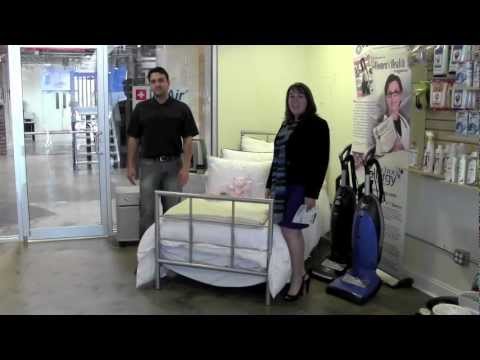
How to allergy proof your bedroom by AchooAllergy.com and AANMA.org
ChannelAchooAllergy.comDescription from the creator
The average person spends about eight hours a night in their bedroom. Whether you sleep alone or with a significant other, you always have unwanted company in the form of dust mites, mold spores, and possibly animal dander. Microscopic mites, in particular, love lounging in your bed, your pillows, and your comforter, feasting away on dead skin flakes. You can't help shedding your skin, but you can put the "No Vacancy" sign out for the mites. Join AchooAllergy.com and AANMA.org to learn more on how to Allergy Proof your bedroom today! achooallergy.com/allergy-proof-your-bedroom.asp
Starve the mites! Then fortify your bedroom with Allergy Armor allergy pillows, organic cotton blankets, hypoallergenic comforters and all natural, certified organic sheets. For all bedding, maintain a dust mite and allergen-free environment by washing bedding with de-mite Laundry Additive or Allersearch Allergen Wash. No matter your allergies or sensitivities, choose the bedding you know will deliver a restful night's sleep.
2. Purify the Air. One cubic foot of air in your home can literally hold millions of fine particles, including allergens like dust mite feces, mold spores, pollen, chemical vapors and odor molecules. One of the easiest ways to improve your indoor air quality is to find the air purifier that's right for you. Using our detailed Air Purifier Buying Guide to select the air filter type and air purifier style that can best meet your filtration needs.
To control populations of dust mites and mold, monitor the humidity with a hygrometer and keep your relative humidity low with a dehumidifier. In homes with dry winter air, a humidifier will provide sinus relief while preventing more dust particles from becoming airborne. Additional way to improve your IAQ (indoor air quality) is by using 3M Furnace/HVAC Filters, Web Vent Filters, and Window Filters.
3. Clean the Carpet. Since the 1950's, wall to wall carpet was something every American family strived to attain. Not until decades later was the link between allergies, asthma and MCS to carpet revealed. Dust mites live deep within carpet fibers, and allergens of all sorts embed themselves and attach to carpet. More recently, the glues and adhesives used in modern carpet production have been linked to chemical sensitivities.
To clean carpets, the vacuum cleaner has been a staple in nearly every household, but traditional vacuum cleaners only clean for appearances. So while they can clean up dirt, they leave behind allergens. Worse still, as tiny particles of dust mites, mold spores and pollen are pulled from the carpet, substandard filtration allows those same particles to be spewed throughout the home and back into the air you breathe.
Sealed system, HEPA vacuum cleaners not only improve the appearance of your carpet by cleaning the mess you can see, but they also effectively trap allergens, and thus work to improve your allergies instead of worsen them. For extra carpet cleaning power, consider using safe, non-toxic cleaning agent that actually take cleaning a step further by denaturing protein allergens. Sprays and powders like DustMiteX and Allersearch X-Mite neutralize allergens, safely and effectively.
About this tutorial
AchooAllergy.com published this 2:07 video tutorial on October 27, 2013. It has been watched 6,783 times on YouTube.
- Channel
- AchooAllergy.com
- Category
- Education
- Duration
- 2:07
- Published
- October 27, 2013
- Views
- 6,783
- Likes
- 46
Tags
Share
This tutorial in other languages
- FRComment l'allergie à l'épreuve votre chambre par AchooAllergy.com et AANMA.org
- ESComo prueba de alergia a su dormitorio por AchooAllergy.com y AANMA.org
- PTComo alergia à prova de seu quarto por AchooAllergy.com e AANMA.org
- ITCome allergia prova la vostra camera da letto da AchooAllergy.com e AANMA.org
- DEWie man Allergie Beweis Ihr Schlafzimmer von AchooAllergy.com und AANMA.org
- NLHoe allergie proof uw slaapkamer door AchooAllergy.com en AANMA.org
- RUКак аллергии доказательство вашей спальне на AchooAllergy.com и AANMA.org
- PLJak alergii dowodu sypialni przez AchooAllergy.com i AANMA.org
- JAどのようにAchooAllergy.comとAANMA.orgによってアレルギー証拠にあなたの寝室
- ARكيفية الحساسية دليل على غرفة النوم الخاصة بك عن طريق AchooAllergy.com وAANMA.org
- HIकैसे एलर्जी सबूत के AchooAllergy.com और AANMA.org द्वारा अपने बेडरूम
- IDCara bukti alergi kamar tidur Anda dengan AchooAllergy.com dan AANMA.org