Playback starts YouTube’s embedded player (privacy-enhanced mode).
How to Prune a Citrus Tree | Citrus | Gardening Australia
ChannelGardening AustraliaDescription from the creator
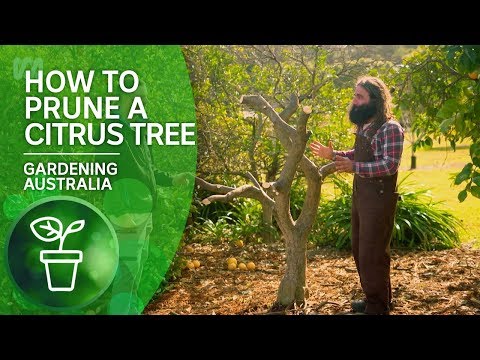
Do you have a mature lemon tree that's really slowing down? Might be time for a 'skeleton prune' to coax it back to vigour. If an old citrus tree has slowed in fruit production, but is still otherwise healthy and has a sound root system, try this method of heavy pruning in late winter or early spring.
Costa visits an awesome orchard in the hills north west of Sydney and meets up with third generation citrus grower, Mark Engall to help him prune an old favorite. Mark's Red Grapefruit (Citrus paradisi cv.) hasn’t been pruned since planting - and it shows. It's lost vigour, has poor foliage coverage in the canopy, plenty of dead wood and small fruit.
00:51 HOW TO SKELETON PRUNE
1. Remove all small dead and damaged branches, and those crossing over or rubbing on others
2. Remove all leaves and twigs cleanly, with sharp pruning tools
3. Cut all the main branches that form the framework of the tree at 2 – 5cm diameter so that only the skeleton remains
4. Assess the skeleton of the tree, and further remove any multi-branched ends
5. Within 18 – 24 months, this tree will come back beautifully, and produce buckets of fruit
a. Trust the process – the tree may be without fruit in the first 12 months as it puts its energy into foliage production, but after that, you’ll be rolling in citrus!
03:51 GRAFTING
Rootstock - the underground and root-forming part of the citrus, generally selected for vigour and disease resistance.
Scion - The “top section” of the plant, grafted onto the rootstock, that will eventually produce the foliage, stems and of course, the flowers.
Process for growing and grafting - it's simple so why not give it a try!
Plant seeds of desired rootstock into pots (Mark uses ‘Flying Dragon’ – a mutation of Citrus trifoliata, highly regarded for it’s dwarfing properties).
After 12 months of growing, rootstock are potted on into individual grow bags
At this stage, during the growing season, the grafting of the bud stock to the rootstock can occur
Select appropriate scion or budstock - individual buds are cut from new growth of the desired citrus – each bud/leaf petiole can become a new citrus tree
Using a sharp budding knife, slice just below the leaf petiole, with the knife almost flat against the stem. Slice upwards, under the bud and remove.
On the rootstock, find a clean, undamaged area of trunk to graft on to and remove thorns and foliage in the area.
Using the budding knife, make a shallow, vertical cut on the stem, and a horizontal shallow slice across the top of the original cut, to form a ‘T’ shape
Using the bark-lifter on the budding knife, gently lift the bark on each side and top of the ‘T’
Slip the prepared bud into the ‘T’ on the rootstock, fold edges of ‘T’ over the bud and trim any excess “tail” from the bud-stock
Wrap area tightly with budding tape to prevent moisture ingress – bud can be covered as it will grow through the tape.
After a month or two, this bud should have begun to grow away, and develop its own foliage. Once this has occurred, the excess top growth of the rootstock can be removed. This ensures all the plants energy and growth is directed into the graft, rather than the rootstock
Watch Gardening Australia on ABC iview: iview.abc.net.au/programs/gardening-australia
SUBSCRIBE: ab.co/GardeningYouTube
About Gardening Australia:
Gardening Australia is an ABC TV program providing gardening know-how and inspiration. Presented by Australia's leading horticultural experts, Gardening Australia is a valuable resource to all gardeners through the television program, the magazine, books, DVDs and extensive online content.
Connect with other Gardening Australia fans:
Like Gardening Australia on Facebook: facebook.com/gardeningaustralia
Follow Gardening Australia on Instagram: instagram.com/gardeningaustralia
Visit the Gardening Australia website: abc.net.au/gardening
This is an official Australian Broadcasting Corporation YouTube channel.
********
Contributions may be removed if they violate ABC's Online Conditions of Use abc.net.au/conditions.htm (Section 3).
Costa visits an awesome orchard in the hills north west of Sydney and meets up with third generation citrus grower, Mark Engall to help him prune an old favorite. Mark's Red Grapefruit (Citrus paradisi cv.) hasn’t been pruned since planting - and it shows. It's lost vigour, has poor foliage coverage in the canopy, plenty of dead wood and small fruit.
00:51 HOW TO SKELETON PRUNE
1. Remove all small dead and damaged branches, and those crossing over or rubbing on others
2. Remove all leaves and twigs cleanly, with sharp pruning tools
3. Cut all the main branches that form the framework of the tree at 2 – 5cm diameter so that only the skeleton remains
4. Assess the skeleton of the tree, and further remove any multi-branched ends
5. Within 18 – 24 months, this tree will come back beautifully, and produce buckets of fruit
a. Trust the process – the tree may be without fruit in the first 12 months as it puts its energy into foliage production, but after that, you’ll be rolling in citrus!
03:51 GRAFTING
Rootstock - the underground and root-forming part of the citrus, generally selected for vigour and disease resistance.
Scion - The “top section” of the plant, grafted onto the rootstock, that will eventually produce the foliage, stems and of course, the flowers.
Process for growing and grafting - it's simple so why not give it a try!
Plant seeds of desired rootstock into pots (Mark uses ‘Flying Dragon’ – a mutation of Citrus trifoliata, highly regarded for it’s dwarfing properties).
After 12 months of growing, rootstock are potted on into individual grow bags
At this stage, during the growing season, the grafting of the bud stock to the rootstock can occur
Select appropriate scion or budstock - individual buds are cut from new growth of the desired citrus – each bud/leaf petiole can become a new citrus tree
Using a sharp budding knife, slice just below the leaf petiole, with the knife almost flat against the stem. Slice upwards, under the bud and remove.
On the rootstock, find a clean, undamaged area of trunk to graft on to and remove thorns and foliage in the area.
Using the budding knife, make a shallow, vertical cut on the stem, and a horizontal shallow slice across the top of the original cut, to form a ‘T’ shape
Using the bark-lifter on the budding knife, gently lift the bark on each side and top of the ‘T’
Slip the prepared bud into the ‘T’ on the rootstock, fold edges of ‘T’ over the bud and trim any excess “tail” from the bud-stock
Wrap area tightly with budding tape to prevent moisture ingress – bud can be covered as it will grow through the tape.
After a month or two, this bud should have begun to grow away, and develop its own foliage. Once this has occurred, the excess top growth of the rootstock can be removed. This ensures all the plants energy and growth is directed into the graft, rather than the rootstock
Watch Gardening Australia on ABC iview: iview.abc.net.au/programs/gardening-australia
SUBSCRIBE: ab.co/GardeningYouTube
About Gardening Australia:
Gardening Australia is an ABC TV program providing gardening know-how and inspiration. Presented by Australia's leading horticultural experts, Gardening Australia is a valuable resource to all gardeners through the television program, the magazine, books, DVDs and extensive online content.
Connect with other Gardening Australia fans:
Like Gardening Australia on Facebook: facebook.com/gardeningaustralia
Follow Gardening Australia on Instagram: instagram.com/gardeningaustralia
Visit the Gardening Australia website: abc.net.au/gardening
This is an official Australian Broadcasting Corporation YouTube channel.
********
Contributions may be removed if they violate ABC's Online Conditions of Use abc.net.au/conditions.htm (Section 3).
About this tutorial
Gardening Australia published this 6:51 video tutorial on October 25, 2019. It has been watched 858,457 times on YouTube.
- Channel
- Gardening Australia
- Category
- Entertainment
- Duration
- 6:51
- Published
- October 25, 2019
- Views
- 858,457
- Likes
- 8,010
Share
This tutorial in other languages
- FRComment tailler un arbre d'agrumes | Citrus | jardinage Australie
- ESCómo podar un árbol de cítricos | cítricos | jardinería Australia
- PTComo podar uma árvore Citrus | Citrus | Gardening Australia
- ITCome potare un albero di agrumi | Citrus | Gardening Australia
- DEWie ein Citrus Baum Prune | Citrus | Garten Australien
- NLHoe maak je een Citrus Tree snoeien | Citrus | tuinieren Australië
- RUКак Сократить цитрусовое дерево | Цитрусовые | Садоводство Австралия
- PLJak przycinać drzewa cytrusowe | Citrus | ogrodnictwo Australia
- JAシトラスツリーを剪定する方法|シトラス|ガーデニングオーストラリア
- ARكيفية تقليم شجرة حمضيات | الحمضيات | البستنة أستراليا
- HIएक खट्टे पेड़ छँटाई कैसे | साइट्रस | बागवानी ऑस्ट्रेलिया
- IDCara Pangkas sebuah pohon jeruk | Citrus | Berkebun Australia