Playback starts YouTube’s embedded player (privacy-enhanced mode).
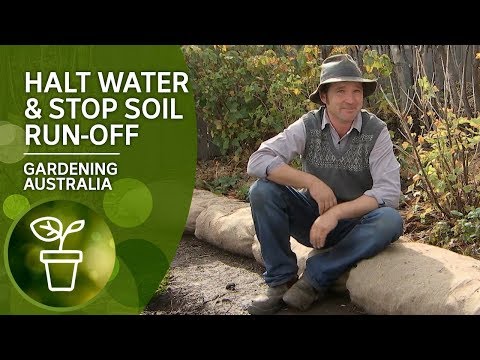
How to slow and capture rainfall... and stop soil run-off!
ChannelGardening AustraliaDescription from the creator
HOW TO ... SLOW AND CAPTURE RAINFALL
Create a Barrier
Whether it’s garden beds, paths, or retaining walls, building across contours slows and catches water.
Retaining Wall 1: The gabion walls at Tino’s are an easy DIY solution. Tino filled the 1.7x.6x.6m mesh boxes with rocks from his property. $100 might seem expensive for a box, but it’s cheap compared to employing a professional to build a retaining wall. They drain beautifully in a spot where a solid brick wall would eventually collapse.
Retaining Wall 2: Hay bales are a fast, cheap way of creating a short-lived retaining wall and if placed in two layers, also offer wind protection. Tino inserts stakes in-between the hay and the twine, rather than directly through the bale. Lay them like bricks and they’ll be stronger. Keeping bales out in the open breaks down weed seeds and when the bales eventually fall apart you can use them as mulch. Tino backfills up to the bales, creating a planting area.
Retaining Wall 3: Hessian 'sausages' are a medium-term solution to slowing and retaining rainfall. They’ll also work perfectly as a retaining wall running across the contour.
Physically Protect the Soil
Hessian and mulch act like shock absorbers stopping heavy rainfall from destroying soil structure. Attach hessian with timber or metal stakes. Straw and compost mulch is fine on flatter slopes, but use heavier bark mulch on steeper sites or it will wash away.
Fibrous-rooted, quick-growing plants like grasses serve double-duty; they protect the soil from rain and bind the soil, preventing it from eroding.
Other Options
When soil starts eroding, channels form and these become the path of least resistance and if left unchecked can become dangerously deep. Get on top of this problem early by placing a barrier of logs or groups of pot plants in the middle of the water’s path to slow and disperse it.
Swales might be a fancy term, but they’re a simple concept. They’re a natural or man-made low tract of land running across the contour of a hill where water naturally pools. Use a mattock and shovel to create mini-swales as temporary rainwater control while plants establish, or make them larger and plant a row of shrubs just below – the water that pools in the swale will be used by the shrubs.
Watch Gardening Australia on ABC iview: iview.abc.net.au/programs/gardening-australia
SUBSCRIBE: ab.co/GardeningYouTube
About Gardening Australia:
Gardening Australia is an ABC TV program providing gardening know-how and inspiration. Presented by Australia's leading horticultural experts, Gardening Australia is a valuable resource to all gardeners through the television program, the magazine, books, DVDs and extensive online content.
Connect with other Gardening Australia fans:
Like Gardening Australia on Facebook: facebook.com/gardeningaustralia
Follow Gardening Australia on Instagram: instagram.com/gardeningaustralia
Visit the Gardening Australia website: abc.net.au/gardening
This is an official Australian Broadcasting Corporation YouTube channel.
********
Contributions may be removed if they violate ABC's Online Conditions of Use abc.net.au/conditions.htm (Section 3).
Create a Barrier
Whether it’s garden beds, paths, or retaining walls, building across contours slows and catches water.
Retaining Wall 1: The gabion walls at Tino’s are an easy DIY solution. Tino filled the 1.7x.6x.6m mesh boxes with rocks from his property. $100 might seem expensive for a box, but it’s cheap compared to employing a professional to build a retaining wall. They drain beautifully in a spot where a solid brick wall would eventually collapse.
Retaining Wall 2: Hay bales are a fast, cheap way of creating a short-lived retaining wall and if placed in two layers, also offer wind protection. Tino inserts stakes in-between the hay and the twine, rather than directly through the bale. Lay them like bricks and they’ll be stronger. Keeping bales out in the open breaks down weed seeds and when the bales eventually fall apart you can use them as mulch. Tino backfills up to the bales, creating a planting area.
Retaining Wall 3: Hessian 'sausages' are a medium-term solution to slowing and retaining rainfall. They’ll also work perfectly as a retaining wall running across the contour.
Physically Protect the Soil
Hessian and mulch act like shock absorbers stopping heavy rainfall from destroying soil structure. Attach hessian with timber or metal stakes. Straw and compost mulch is fine on flatter slopes, but use heavier bark mulch on steeper sites or it will wash away.
Fibrous-rooted, quick-growing plants like grasses serve double-duty; they protect the soil from rain and bind the soil, preventing it from eroding.
Other Options
When soil starts eroding, channels form and these become the path of least resistance and if left unchecked can become dangerously deep. Get on top of this problem early by placing a barrier of logs or groups of pot plants in the middle of the water’s path to slow and disperse it.
Swales might be a fancy term, but they’re a simple concept. They’re a natural or man-made low tract of land running across the contour of a hill where water naturally pools. Use a mattock and shovel to create mini-swales as temporary rainwater control while plants establish, or make them larger and plant a row of shrubs just below – the water that pools in the swale will be used by the shrubs.
Watch Gardening Australia on ABC iview: iview.abc.net.au/programs/gardening-australia
SUBSCRIBE: ab.co/GardeningYouTube
About Gardening Australia:
Gardening Australia is an ABC TV program providing gardening know-how and inspiration. Presented by Australia's leading horticultural experts, Gardening Australia is a valuable resource to all gardeners through the television program, the magazine, books, DVDs and extensive online content.
Connect with other Gardening Australia fans:
Like Gardening Australia on Facebook: facebook.com/gardeningaustralia
Follow Gardening Australia on Instagram: instagram.com/gardeningaustralia
Visit the Gardening Australia website: abc.net.au/gardening
This is an official Australian Broadcasting Corporation YouTube channel.
********
Contributions may be removed if they violate ABC's Online Conditions of Use abc.net.au/conditions.htm (Section 3).
About this tutorial
Gardening Australia published this 5:21 video tutorial on November 2, 2019. It has been watched 122,960 times on YouTube.
- Channel
- Gardening Australia
- Category
- Entertainment
- Duration
- 5:21
- Published
- November 2, 2019
- Views
- 122,960
- Likes
- 1,614
Tags
Share
This tutorial in other languages
- FRComment ralentir et précipitations de capture ... et le sol stop ruissellement!
- ESCómo reducir la velocidad y la captura de la lluvia ... y el suelo parada escorrentía!
- PTComo retardar e captura de chuva ... e parada solo run-off!
- ITCome per rallentare e la cattura pioggia ... e suolo fermata run-off!
- DEWie zu verlangsamen und zu erfassen Niederschläge ... und Stop Boden Run-off!
- NLHoe te vertragen en capture regenval ... en stop bodem run-off!
- RUКак замедлить и захват осадков ... и остановка почвы стекание!
- PLJak spowolnić i przechwytywania opady ... i gleby przystanek run-off!
- JA降雨...ストップ土壌の流出を遅くして撮影する方法!
- ARكيفية إبطاء والتقاط الأمطار ... وتوقف التربة الاعادة!
- HIकैसे धीमी गति से और कब्जा वर्षा ... और बंद मिट्टी रन बंद करने के लिए!
- IDBagaimana untuk memperlambat dan menangkap curah hujan ... dan berhenti tanah run-off!