Playback starts YouTube’s embedded player (privacy-enhanced mode).
How to Avoid Run-On Sentences
ChannelHowcastDescription from the creator
Full Playlist: youtube.com/playlist?list=PLLALQuK1NDrhv4EBL5C8…
-
-
Watch more English Grammar Basics videos: howcast.com/videos/346250-How-to-Avoid-RunOn-Se…
A run-on sentence comprises two parts that should stand alone as separate sentences, but have been combined into one overlong sentence.
Step 1: Create two sentences
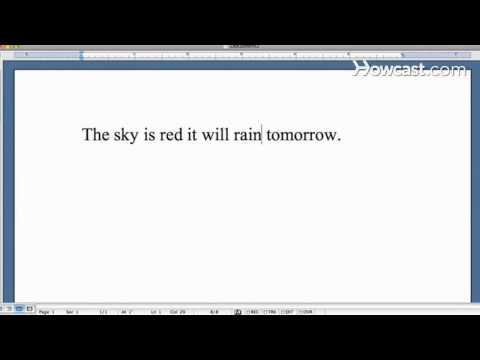
Break the two independent clauses in a run-on into two sentences. For example, rewrite the run-on sentence, "The sky is red it will rain tomorrow," as "The sky is red. It will rain tomorrow."
Tip
An independent clause is a group of words that contains a subject and verb and expresses a complete thought.
Step 2: Use a conjunction
Connect the two independent clauses with a comma followed by a conjunction, such as and, but, for, nor, yet, or, or so. For example, rewrite "The sky is red it will rain tomorrow" as "The sky is red, so it will rain tomorrow."
Step 3: Use a semicolon
Connect the two independent clauses with a semicolon if the clauses are short and closely related. For example, rewrite "The sky is red it will rain tomorrow" as "The sky is red; it will rain tomorrow."
Step 4: Use a long conjunction
Connect the two independent clauses with a longer conjunction; such as however, moreover, nevertheless, therefore, or consequently. Place a semicolon in front and a comma behind the conjunction. For example, rewrite "The sky is red it will rain tomorrow" as "The sky is red; consequently, it will rain tomorrow."
Did You Know?
Marcel Proust once wrote a grammatically sound sentence that went on for three pages.
-
-
Watch more English Grammar Basics videos: howcast.com/videos/346250-How-to-Avoid-RunOn-Se…
A run-on sentence comprises two parts that should stand alone as separate sentences, but have been combined into one overlong sentence.
Step 1: Create two sentences
Break the two independent clauses in a run-on into two sentences. For example, rewrite the run-on sentence, "The sky is red it will rain tomorrow," as "The sky is red. It will rain tomorrow."
Tip
An independent clause is a group of words that contains a subject and verb and expresses a complete thought.
Step 2: Use a conjunction
Connect the two independent clauses with a comma followed by a conjunction, such as and, but, for, nor, yet, or, or so. For example, rewrite "The sky is red it will rain tomorrow" as "The sky is red, so it will rain tomorrow."
Step 3: Use a semicolon
Connect the two independent clauses with a semicolon if the clauses are short and closely related. For example, rewrite "The sky is red it will rain tomorrow" as "The sky is red; it will rain tomorrow."
Step 4: Use a long conjunction
Connect the two independent clauses with a longer conjunction; such as however, moreover, nevertheless, therefore, or consequently. Place a semicolon in front and a comma behind the conjunction. For example, rewrite "The sky is red it will rain tomorrow" as "The sky is red; consequently, it will rain tomorrow."
Did You Know?
Marcel Proust once wrote a grammatically sound sentence that went on for three pages.
About this tutorial
Howcast published this 1:48 video tutorial on October 29, 2010. It has been watched 41,952 times on YouTube.
- Channel
- Howcast
- Category
- Howto & Style
- Duration
- 1:48
- Published
- October 29, 2010
- Views
- 41,952
- Likes
- 142
Tags
Share
This tutorial in other languages
- FRComment éviter les peines d'exécution sur
- ESCómo evitar sentencias de marcha en inercia
- PTComo evitar Run-em sentenças
- ITCome evitare Run-On Sentenze
- DEWie zu vermeiden Run-On-Sätze
- NLHoe te vermijden Run-On Zinnen
- RUКак избежать Run-On Sentences
- PLJak uniknąć Run-przy zdaniach
- JAラン・オンの文を回避する方法
- ARكيفية تجنب التشغيل في الجمل
- HIकैसे बचें रन-पर वाक्य
- IDCara Hindari Run-On Kalimat