Playback starts YouTube’s embedded player (privacy-enhanced mode).
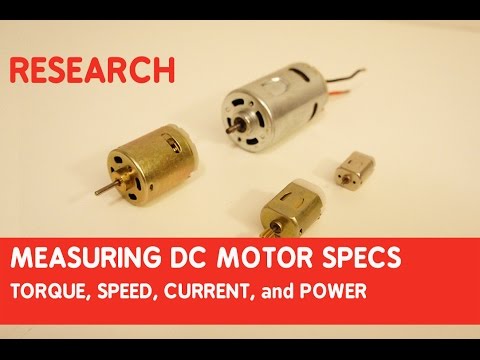
How to measure DC motor specs: torque, speed, current, and power
ChannelResearch and BuildDescription from the creator
Measuring the specifications of a DC motor of unknown torque/power.
Measuring RPM, then Measuring Torque to create a torque/speed curve for the motor.
DC motors are pretty much linear , the faster they turn, the less torque they have. Max torque occurs at stall (as does maximum current)
Drawing the torque-speed curve can be done by measuring the no-load top speed and then measuring the stall torque. Now any point along the graph can give you an estimate of the motor's speed and the torque at that speed.
The torque speed "curve" can also give you an estimate on how much current draw the motor will require.
You can caculate the actual mechanical output power of the motor by using the RPM and the torque together.
Be aware that maximum EFFICIENCY, where the electrical energy is converted maximally to mechanical energy, isn't at the same point of maximum motor mechanical power. Typically max efficiency is around 75% of motor's no load speed.
This particular motor could no doubt put out up to even 140watts with higher voltages.
The best way to measure would be to use a dynamometer, or a "ponybrake", but I have not built one of those yet, so doing it this way will work to give you an estimate of what the motor can do
Measuring RPM, then Measuring Torque to create a torque/speed curve for the motor.
DC motors are pretty much linear , the faster they turn, the less torque they have. Max torque occurs at stall (as does maximum current)
Drawing the torque-speed curve can be done by measuring the no-load top speed and then measuring the stall torque. Now any point along the graph can give you an estimate of the motor's speed and the torque at that speed.
The torque speed "curve" can also give you an estimate on how much current draw the motor will require.
You can caculate the actual mechanical output power of the motor by using the RPM and the torque together.
Be aware that maximum EFFICIENCY, where the electrical energy is converted maximally to mechanical energy, isn't at the same point of maximum motor mechanical power. Typically max efficiency is around 75% of motor's no load speed.
This particular motor could no doubt put out up to even 140watts with higher voltages.
The best way to measure would be to use a dynamometer, or a "ponybrake", but I have not built one of those yet, so doing it this way will work to give you an estimate of what the motor can do
About this tutorial
Research and Build published this 4:13 video tutorial on November 7, 2017. It has been watched 185,121 times on YouTube.
- Channel
- Research and Build
- Category
- Howto & Style
- Duration
- 4:13
- Published
- November 7, 2017
- Views
- 185,121
- Likes
- 1,496
Tags
Share
This tutorial in other languages
- FRComment mesurer les caractéristiques du moteur à courant continu: couple, vitesse, courant et puissance
- ESCómo medir las especificaciones de motor de corriente continua: par, velocidad, corriente y potencia
- PTComo medir especificações de motor DC: torque, velocidade, corrente e potência
- ITCome misurare caratteristiche motori DC: coppia, velocità, corrente e potenza
- DEWie man misst DC-Motor-Spezifikationen: Drehmoment, Drehzahl, Strom und Leistung
- NLHoe kan ik DC motor specs meten: koppel, snelheid, stroom, en macht
- RUКак измерить двигательные функции DC: крутящий момент, скорость, ток и мощность
- PLJak mierzyć specyfikacje silnik DC: moment obrotowy, prędkość, prąd i moc
- JAトルク、速度、電流、電力:DCモータの仕様を測定する方法
- ARكيفية قياس المواصفات محرك DC: عزم الدوران، والسرعة، والحالية، والسلطة
- HIकैसे डीसी मोटर चश्मा को मापने के लिए: टोक़, गति, वर्तमान, और बिजली
- IDBagaimana mengukur DC spesifikasi bermotor: torsi, kecepatan, saat ini, dan kekuasaan