Playback starts YouTube’s embedded player (privacy-enhanced mode).
How to Solve a Sudoku Game
ChannelHowcastIn brief
Master the logic behind solving Sudoku puzzles, from identifying the grid structure to applying cross-hatching and elimination techniques. This method works for beginners and intermediate players looking to tackle puzzles systematically.
Key steps
- Recognize the 81 squares, 9 boxes, and 3x3 grid layout of a Sudoku puzzle.
- Fill rows, columns, and boxes with numbers 1–9 without repetition.
- Start with easy puzzles, using pre-filled squares to deduce missing numbers.
- Apply cross-hatching: eliminate numbers already in the same row, column, or box.
- Fill in as many squares as possible in one box before moving to the next.
- Repeat cross-hatching across all boxes until the puzzle is complete.
- Use the counting method to disqualify numbers in empty squares based on existing placements.
- Practice to refine strategies for harder puzzles.
Questions & answers
What’s the minimum number of pre-filled squares in a solvable Sudoku puzzle?
At least 17 squares must be filled in for a puzzle to have a single solution.
How do I know which box to start with?
Begin with the box that has the most obvious deductions from pre-filled numbers.
Description from the creator
Full Playlist: youtube.com/playlist?list=PLLALQuK1NDrgfJadxExf…
-
-
Watch more Puzzles & Brain Teasers videos: howcast.com/videos/202656-How-to-Solve-a-Sudoku…
Sudoku is a one-rule puzzle game that can be either satisfyingly simple or deceptively difficult.
Step 1:
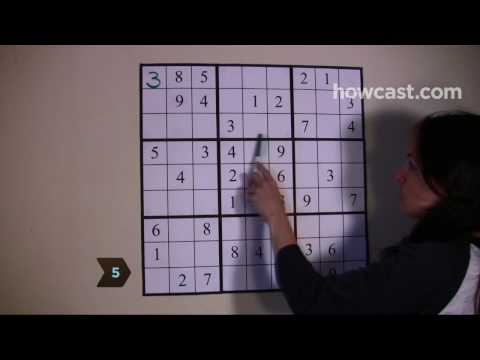
Understand the pattern of a sudoku puzzle. Cells where an individual number goes are called squares; squares are then sectioned off in groups of nine to create boxes. A sudoku puzzle has a total of 81 squares, and nine boxes. They create a three-box-by-three-box grid.
Tip
Many sudoku puzzles have dark lines separating the nine three-square-by-three-square boxes for easy identification.
Step 2:
To solve a sudoku puzzle, each row of nine squares must contain the numbers 1 through 9. Each column must also contain the numbers 1 through 9, and each box must contain the numbers 1 through 9. No row, column, or box may repeat any number.
Step 3:
Start with an easy puzzle, and work your way up to successively more difficult puzzles. Many squares will already be filled in, no matter the puzzle level. Based on those filled in squares, using logic and the process of elimination, begin deducing which numbers fit in the empty squares.
Tip
Any puzzle that has one single solution will have at least 17 squares already filled in.
Step 4:
Use cross-hatching, the process of figuring out where a number fits by eliminating possibilities based on numbers in the other squares in the same row, column, and box. For example, if the top-middle box contains no number 8, and the other boxes along the top row of the sudoku board contain 8s in the first and second rows, process of elimination dictates the 8 in the upper-middle box must be in the third row.
Step 5:
Once you've solved one square by cross-hatching, use the technique to fill in as many squares in that single box as you can.
Step 6:
Once you have exhausted one box, either by filling it in completely or running out of discoverable solutions, continue to the next box, then the next box, until you've gone through all nine boxes.
Step 7:
Typically, by doing simple cross-hatching you will fill in several squares. Once you've gone through all the boxes, return to the box you started with and repeat the process, as it's likely there are now more available solutions.
Step 8:
After cross-hatching, try the counting method. Look at a single square, and count 1 through 9 through all possibilities, marking off ones that are immediately disqualified because it already appears either in the same box, the same column, or in the same row as the empty square.
Step 9:
For most easy puzzles, these simple techniques should be sufficient to help you complete the puzzle. As you practice, you'll be able to develop your own strategies and think ahead, which will help you progress on to more difficult puzzles.
Did You Know?
Sudoku, despite its Japanese name, was invented in the U.S. in 1979 by a 74-year-old retired architect.
-
-
Watch more Puzzles & Brain Teasers videos: howcast.com/videos/202656-How-to-Solve-a-Sudoku…
Sudoku is a one-rule puzzle game that can be either satisfyingly simple or deceptively difficult.
Step 1:
Understand the pattern of a sudoku puzzle. Cells where an individual number goes are called squares; squares are then sectioned off in groups of nine to create boxes. A sudoku puzzle has a total of 81 squares, and nine boxes. They create a three-box-by-three-box grid.
Tip
Many sudoku puzzles have dark lines separating the nine three-square-by-three-square boxes for easy identification.
Step 2:
To solve a sudoku puzzle, each row of nine squares must contain the numbers 1 through 9. Each column must also contain the numbers 1 through 9, and each box must contain the numbers 1 through 9. No row, column, or box may repeat any number.
Step 3:
Start with an easy puzzle, and work your way up to successively more difficult puzzles. Many squares will already be filled in, no matter the puzzle level. Based on those filled in squares, using logic and the process of elimination, begin deducing which numbers fit in the empty squares.
Tip
Any puzzle that has one single solution will have at least 17 squares already filled in.
Step 4:
Use cross-hatching, the process of figuring out where a number fits by eliminating possibilities based on numbers in the other squares in the same row, column, and box. For example, if the top-middle box contains no number 8, and the other boxes along the top row of the sudoku board contain 8s in the first and second rows, process of elimination dictates the 8 in the upper-middle box must be in the third row.
Step 5:
Once you've solved one square by cross-hatching, use the technique to fill in as many squares in that single box as you can.
Step 6:
Once you have exhausted one box, either by filling it in completely or running out of discoverable solutions, continue to the next box, then the next box, until you've gone through all nine boxes.
Step 7:
Typically, by doing simple cross-hatching you will fill in several squares. Once you've gone through all the boxes, return to the box you started with and repeat the process, as it's likely there are now more available solutions.
Step 8:
After cross-hatching, try the counting method. Look at a single square, and count 1 through 9 through all possibilities, marking off ones that are immediately disqualified because it already appears either in the same box, the same column, or in the same row as the empty square.
Step 9:
For most easy puzzles, these simple techniques should be sufficient to help you complete the puzzle. As you practice, you'll be able to develop your own strategies and think ahead, which will help you progress on to more difficult puzzles.
Did You Know?
Sudoku, despite its Japanese name, was invented in the U.S. in 1979 by a 74-year-old retired architect.
About this tutorial
Howcast published this 2:57 video tutorial on October 29, 2009. It has been watched 4,811,888 times on YouTube.
- Channel
- Howcast
- Category
- Howto & Style
- Duration
- 2:57
- Published
- October 29, 2009
- Views
- 4,811,888
- Likes
- 27,822
Tags
Share
This tutorial in other languages
- FRComment résoudre un Sudoku Game
- ESCómo solucionar un juego de Sudoku
- PTComo resolver um jogo de Sudoku
- ITCome risolvere un Sudoku
- DESo lösen Sie ein Sudoku-Spiel
- NLHoe op te lossen een Sudoku Game
- RUКак решить судоку игры
- PLJak rozwiązać Sudoku
- JA数独ゲームを解決する方法
- ARكيفية حل لعبة سودوكو
- HIकैसे एक सुडोकू खेल का समाधान करने के लिए
- IDCara Mengatasi Game Sudoku