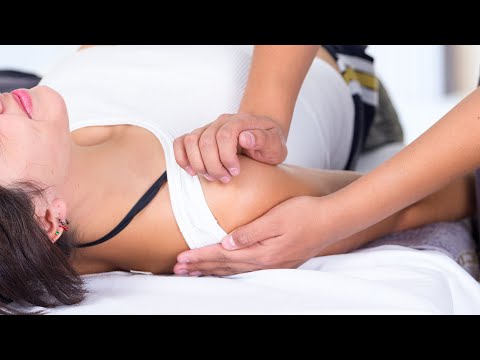
Playback starts YouTube’s embedded player (privacy-enhanced mode).
How to treat a dislocated shoulder? - Dr. Nagesh H S
ChannelDoctors' Circle - World's Largest Health PlatformDescription from the creator
Dislocation, 2 articular surfaces lose contact between each other or one of the articular surfaces comes out of the other articular surface, that is called dislocation. For eg., in the should joint, when the head of the humerus and the glenoid cavity of the scapula are in articulation with each other, this is the normal position. When the head of the humerus comes out of the scapula as shown in the video, that is known as shoulder dislocation..
There are two types of shoulder dislocation. If the head comes to the front, its called anterior dislocation and if it comes to the back of the scapula, it is called as posterior dislocation. The most common one is the anterior dislocation..
When the dislocation happens, the soft tissue, the capsule and other structures what are covering in the anterior aspect will get torn and then the dislocation happens..
The causes for dislocation are trauma or a fall while playing or someone forcibly pulling or with electric shock. Some people are more prone for dislocation. The people who are present with laxity of ligaments are more prone for shoulder dislocation where the scapula structures are laxed..
So patients with deformity in the shoulder and arms fixed and unable to move. Patients come to the doctor in this position. The hand is fixed in extension position and dropped down. The arms cannot be moved. Dislocation is a severe, painful condition. When we examine the patients, there will be a hollow in the shoulder region. Usually, the shoulder is bulky due to the head of the humerus & when the head of the humerus comes down, the bulkiness is absent. This is an important sign for dislocation, The other sign is called Dugas test - i.e when the articulation is normal, the person can touch the other shoulder. In shoulder dislocation, this position is not possible..
The next important thing is to put the head into the position. There are many techniques of reducing the dislocation. Some people are very very pain sensitive while some people can tolerate the pain. If the patient is very sensitive to pain, we will take the help of anesthesia while reducing the dislocation. My preference is to always do it without anesthesia. I have been very successful following a very simple procedure without much pain. The problem with anesthesia is that in case the patient has taken food, we have to wait for four to six hours before giving anesthesia which means the patient has to tolerate the pain for four to six hours..
After the dislocation is reduced, we re-confirm this by using the Dugas test. Afterwards, the patient has to use a shoulder immobilizer for three weeks as the soft tissue takes three weeks to heal. The patient will also have to meet the doctor periodically and some exercises also have to be done..
If the dislocation happens repeatedly, we have to really understand what happens inside the shoulder. We have to take an MRI scan to understand the severity of damage to the capsule. Usually the inferior capsule and the anterior capsule will be torn which is called as a Bankart Lesion and when the head goes out and the bone gets damaged, it is called as Hill Sachs lesion. If MRI shows these findings, we suggest the patient to undergo surgical repair of this part so that the results will be good and further dislocation charges will be reduced..
When it comes to surgery, in the olden days, we were doing an open procedure where in we put an incision cut, open all the muscles and stitch it back. Nowadays, arthroscopy is done. In arthroscopy, some keyhole incisions, one in the front, one in the side or one in the back depending on the position where in we put a single stitch and camera will be passed inside through one keyhole, instruments through the other. We will follow on TV and then fix it. The advantages of arthroscopy is that it is minimally invasive and early rehabilitation for the patient. Patient can go back the same day, shoulder arthroscopy is done as a day care operation and within two to three days, the patients can go back to work also. After the surgery, the patients have to use an immobilizer for four to six weeks..
About this tutorial
Doctors' Circle - World's Largest Health Platform published this 12:41 video tutorial on November 3, 2015. It has been watched 2,697 times on YouTube.
- Category
- People & Blogs
- Duration
- 12:41
- Published
- November 3, 2015
- Views
- 2,697
- Likes
- 7
Tags
Share
This tutorial in other languages
- FRComment traiter une luxation de l'épaule? - Dr Nagesh H S
- ESCómo tratar una luxación en el hombro? - Dr. Nagesh H S
- PTComo tratar um ombro deslocado? - Dr. Nagesh H S
- ITCome per il trattamento di una lussazione della spalla? - Dr. Nagesh H S
- DEWie eine Schulter ausgerenkt zu behandeln? - Dr. Nagesh H S
- NLHoe maak je een schouder uit de kom te behandelen? - Dr. Nagesh Hs
- RUКак лечить вывих плеча? - Д-р Н Нагеш S
- PLJak leczyć zwichnął ramię? - Dr Nagesh H S
- JA脱臼肩を治療する方法は? - 博士ネージッシュH S
- ARكيفية علاج اصابته بخلع في الكتف؟ - الدكتور ناغيش H S
- HIकैसे एक उखड़ कंधे के इलाज के लिए? - डॉ नागेश एच एस
- IDBagaimana untuk mengobati dislokasi bahu? - Dr Nagesh H S