Playback starts YouTube’s embedded player (privacy-enhanced mode).
How To Soundproof A Basement - www.AcousticFields.com
ChannelAcoustic FieldsDescription from the creator
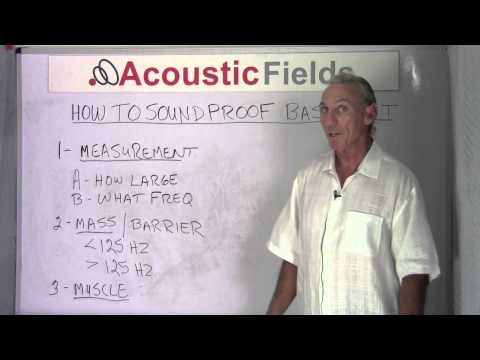
Today's video is all about how to soundproof a basement. For this task we employ the 3 m's, Measurement, Mass and Muscle. In the video I explain what these are, why you have a lot working in your favor by using a basement, and why the ceiling is your main area of focus.
If you have any follow questions on how to soundproof a basement, please leave them in the comments section and I'll be happy to answer them.
Make sure to Like, Favorite and Share this video and Subscribe to my Acoustic Fields channel if you haven't done so already at
youtube.com/subscription_center?add_user=acoust…
SCHEDULE
Wednesdays:
Latest Room Acoustic Training Video goes live
youtube.com/user/AcousticFields
Tuesdays 11am EST:
Ask Dennis live - Your Acoustic Treatment Questions Answered live in our weekly Google Hangout
plus.google.com/+Acousticfields101/
Other Great Resources
Acoustic Fields Website
acousticfields.com
acousticfields.com/blog
Follow me
plus.google.com/+Acousticfields101/
facebook.com/acousticfields
twitter.com/mikesorensen06 - my partners Twitter account
Here's the full transcript of the above video:
Hi everyone, Dennis Foley from Acoustic Fields.
Today we're going to talk about how to soundproof a basement. For those of you that are fortunate enough to have a basement a lot of your work is done for you as far as barrier technology but we'll talk to that a little bit and address that issue later.
So how to soundproof a basement. We're going to call it the 3 M's:
Measurement, Mass and Muscle.
So those are the three areas that we need to focus on so let's take a look at each one of those and talk a little bit about each one. The first one's measurement.
So what is our issues? What are we trying to figure out? Let's put a number to it.
Putting a number to it makes it a lot easier because the number will tell us how much mass we need to use in our barrier to keep noise out or to keep noise in.
It also tells how much labor we're gonna need and materials.
So that's really good on estimating job prices and costs. So if we measure, if we take a reading of what the noise level is in the room or the basement and what we're trying to
accomplish.
Do we have a noisy source outside the basement? Is that our problem? Do we have noise coming into the structure?
So we need to figure out just how much that is, how big a problem it is?
Or are we generating the sound or the noise that's leaking out?
Maybe upstairs if it's a house structure.
So what are we, what are we doing? You know what, how big is our problem? Let's put a number
to it and measure it first and then we need to decide what frequency its at.
Deciding what frequency its at is really important because it tells us what kind of mass or barrier, which is step two, that were gonna have to construct to contain noise or isolate from outside source noise. So defining how big our problem is,
what frequency its at, will help us determine what kind of mass or barrier technology we need to apply to the situation.
Two break points we need to look at. Noise that's below 125 cycles big difference in the amount, type and construction methods that you used to create a barrier for that anything below 125 cycles. Now we're really getting into the low frequency area.
Above 125 cycles human voice and up, a little bit different. Less mass, less space requirement.
Below 125 cycles, way more mass and usually more space requirements. So how big of a problem do we have? What frequency is it at?
Where's our break point in those problems? Is it above 125 cycles? Is it below 125 cycles? We need to determine that first? Muscle. Constructing barrier technology is labor-intensive and the materials weigh a lot.
You have to arrange them in a certain way to get the most isolation so all that needs to be taken into consideration.
In a basement you have Earth and usually concrete.
So you already have a natural barrier with the earth and you have usually thick poured concrete walls. So you have two good things going for you in terms of outside noise coming in. It won't help with the people upstairs in the top part of the house if it is a residential situation so the ceiling now becomes the issue and we have to work on constructing barrier technology for that.
So with a basement you kinda got a built-in outside barrier with the earth and the concrete but then we have energy that goes upstairs.
Here's another thing you have to realize with low frequency energy in a basement, with concrete and the earth, the low-frequency has nowhere to go but up into the house.
The earth and the concrete are going to be really good barriers for that. It's not going to have anywhere to go and it will find the path of least resistance usually through the ceiling.
So that's an area that we need to be aware of.
Measurement, Mass and Muscle, the 3 M's in how to soundproof a basement. Thank you.
If you have any follow questions on how to soundproof a basement, please leave them in the comments section and I'll be happy to answer them.
Make sure to Like, Favorite and Share this video and Subscribe to my Acoustic Fields channel if you haven't done so already at
youtube.com/subscription_center?add_user=acoust…
SCHEDULE
Wednesdays:
Latest Room Acoustic Training Video goes live
youtube.com/user/AcousticFields
Tuesdays 11am EST:
Ask Dennis live - Your Acoustic Treatment Questions Answered live in our weekly Google Hangout
plus.google.com/+Acousticfields101/
Other Great Resources
Acoustic Fields Website
acousticfields.com
acousticfields.com/blog
Follow me
plus.google.com/+Acousticfields101/
facebook.com/acousticfields
twitter.com/mikesorensen06 - my partners Twitter account
Here's the full transcript of the above video:
Hi everyone, Dennis Foley from Acoustic Fields.
Today we're going to talk about how to soundproof a basement. For those of you that are fortunate enough to have a basement a lot of your work is done for you as far as barrier technology but we'll talk to that a little bit and address that issue later.
So how to soundproof a basement. We're going to call it the 3 M's:
Measurement, Mass and Muscle.
So those are the three areas that we need to focus on so let's take a look at each one of those and talk a little bit about each one. The first one's measurement.
So what is our issues? What are we trying to figure out? Let's put a number to it.
Putting a number to it makes it a lot easier because the number will tell us how much mass we need to use in our barrier to keep noise out or to keep noise in.
It also tells how much labor we're gonna need and materials.
So that's really good on estimating job prices and costs. So if we measure, if we take a reading of what the noise level is in the room or the basement and what we're trying to
accomplish.
Do we have a noisy source outside the basement? Is that our problem? Do we have noise coming into the structure?
So we need to figure out just how much that is, how big a problem it is?
Or are we generating the sound or the noise that's leaking out?
Maybe upstairs if it's a house structure.
So what are we, what are we doing? You know what, how big is our problem? Let's put a number
to it and measure it first and then we need to decide what frequency its at.
Deciding what frequency its at is really important because it tells us what kind of mass or barrier, which is step two, that were gonna have to construct to contain noise or isolate from outside source noise. So defining how big our problem is,
what frequency its at, will help us determine what kind of mass or barrier technology we need to apply to the situation.
Two break points we need to look at. Noise that's below 125 cycles big difference in the amount, type and construction methods that you used to create a barrier for that anything below 125 cycles. Now we're really getting into the low frequency area.
Above 125 cycles human voice and up, a little bit different. Less mass, less space requirement.
Below 125 cycles, way more mass and usually more space requirements. So how big of a problem do we have? What frequency is it at?
Where's our break point in those problems? Is it above 125 cycles? Is it below 125 cycles? We need to determine that first? Muscle. Constructing barrier technology is labor-intensive and the materials weigh a lot.
You have to arrange them in a certain way to get the most isolation so all that needs to be taken into consideration.
In a basement you have Earth and usually concrete.
So you already have a natural barrier with the earth and you have usually thick poured concrete walls. So you have two good things going for you in terms of outside noise coming in. It won't help with the people upstairs in the top part of the house if it is a residential situation so the ceiling now becomes the issue and we have to work on constructing barrier technology for that.
So with a basement you kinda got a built-in outside barrier with the earth and the concrete but then we have energy that goes upstairs.
Here's another thing you have to realize with low frequency energy in a basement, with concrete and the earth, the low-frequency has nowhere to go but up into the house.
The earth and the concrete are going to be really good barriers for that. It's not going to have anywhere to go and it will find the path of least resistance usually through the ceiling.
So that's an area that we need to be aware of.
Measurement, Mass and Muscle, the 3 M's in how to soundproof a basement. Thank you.
About this tutorial
Acoustic Fields published this 4:21 video tutorial on October 29, 2014. It has been watched 11,412 times on YouTube.
- Channel
- Acoustic Fields
- Category
- Science & Technology
- Duration
- 4:21
- Published
- October 29, 2014
- Views
- 11,412
- Likes
- 69
Tags
Share
This tutorial in other languages
- FRComment insonoriser un sous-sol - www.AcousticFields.com
- ESCómo insonorizar un sótano - www.AcousticFields.com
- PTComo prova de som A Cave - www.AcousticFields.com
- ITCome insonorizzato una cantina - www.AcousticFields.com
- DEWie man Schall A Keller - www.AcousticFields.com
- NLHow To Soundproof A Basement - www.AcousticFields.com
- RUКак Звукоизолированный Подвал - www.AcousticFields.com
- PLJak wyciszona piwnicy - www.AcousticFields.com
- JAどのようにするには防音A地下室 - www.AcousticFields.com
- ARكيفية عازلة للصوت وبدروم - www.AcousticFields.com
- HIकैसे Soundproof एक तलघर - www.AcousticFields.com
- IDCara Soundproof A Basement - www.AcousticFields.com