Playback starts YouTube’s embedded player (privacy-enhanced mode).
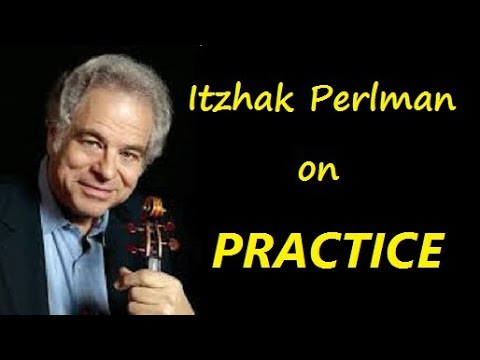
How to practice - some expert advice from Itzhak Perlman.
ChannelMusicOnline UKDescription from the creator
Want a DISTINCTION in YOUR next ABRSM Exam?
music-online.org.uk/2019/01/how-to-get-distinct…
How to practice - some expert advice from Itzhak Perlman, the world famous Israeli-American violinist, conductor and pedagogue. Invaluable for anyone taking an ABRSM music exam.
OK you know everybody is talking to me about practising and whats the deal about practising and how much should you practise. So now obviously if you're very talented practising is very very important. When I was growing up I practised basically 3 hours every day and a lot of my students fell sometimes and wrongly so, that if you practice more it's going to be better, so if you practise 5 hours it's better, if you practise 8 hours it's even better. And the answer to this is it's wrong. Don't practise more than four to five hours, that's a tip I can give you if you are very serious because afterwards it's not useful anymore. The body doesn't absorb any more stuff. As a matter of fact you can cause yourself having little physical problems with your wrist and so on and so forth. So I would say 4 to 5 hours for ambitious fiddle players, yes?And as I said personally 3 hours was fine. Number 2. When you practice it has to be slow. You cannot practise impatiently. You know, putting in the time of practising is not enough. I would rather practise in your head for 2 hours than somebody else, just mindlessly for 8. Cause that doesn't work. So I can tell you that if you want to practise correctly, number 1, slowly. Number 2, have an agenda. Why do you want to practise, you know, make sure that you practise in small sections. You want to make sure that you don't repeat anything without actually hearing what you are doing. Because when you repeat certain things and for example let's say that you practise something for the bow, and you keep repeating it and then you you're playing it slightly out of tune, then you're actually practising to play out of tune. That's why you have to actually really listen very carefully to what you are doing. And so on. So, I know that this is very, very general, but at least the important thing is to do it very slowly and to do in small sections and to have patience. If something sounds great on Monday, and it does not sound so good on Tuesday, don't give up, it means that it's not yet there. Keep practising slowly again and again and by Wednesday it will be slightly better and by Thursday it will be even more better but patience is very very important. Let's talk a little bit about nerves. Nerves, you can't get rid of nerves really. The only thing that you can do about nerves is to be familiar with nerves. So that when you're nervous when you play, then you know actually what happens to you personally and sometimes you might think that you're gonna get nervous and it might not happen. And sometimes you say "Oh I'm never gonna get nervous, you tonight, I feel so good and all of a sudden on stage you start to get the jitters. Don't be surprised, just be familiar with what happens to you. Everybody is individual, you know, some people stop playing very outwardly, you know they play play very inwardly and very privately when they get nervous, they're afraid to express themselves. That's one of the things that happens. Some people their bow shakes. Everybody has a different kind of thing but as long as you actually remember what happens to you and just say "OH I know that. That's what happens to me, I'm gonna try and deal with it. That's one way of dealing with nerves, not so much getting rid of nerves but dealing with nerves. ~~~~~~~~~~~~~~~~~~~~~~~~~~~~~~~~~~~~~~~~~~~~~~~~~~~~~~~~~~~~~~~~~~~~~~~~~~~~~~~~~~~~~~~~~~~~~~~~~~~~~~~~~~~~~~~~~~~~~~~~~~~~~~~~~~~~~~
Listen to MusicOnline UK on Spotify open.spotify.com/album/7Cbh8cZ9RHTwqdPlZxGHQc ~~~~~~~~~~~
Join this channel to get access to perks:
youtube.com/channel/UC4xqQPQuxdxPbwfa5GYm_rQ/jo…
music-online.org.uk/2019/01/how-to-get-distinct…
How to practice - some expert advice from Itzhak Perlman, the world famous Israeli-American violinist, conductor and pedagogue. Invaluable for anyone taking an ABRSM music exam.
OK you know everybody is talking to me about practising and whats the deal about practising and how much should you practise. So now obviously if you're very talented practising is very very important. When I was growing up I practised basically 3 hours every day and a lot of my students fell sometimes and wrongly so, that if you practice more it's going to be better, so if you practise 5 hours it's better, if you practise 8 hours it's even better. And the answer to this is it's wrong. Don't practise more than four to five hours, that's a tip I can give you if you are very serious because afterwards it's not useful anymore. The body doesn't absorb any more stuff. As a matter of fact you can cause yourself having little physical problems with your wrist and so on and so forth. So I would say 4 to 5 hours for ambitious fiddle players, yes?And as I said personally 3 hours was fine. Number 2. When you practice it has to be slow. You cannot practise impatiently. You know, putting in the time of practising is not enough. I would rather practise in your head for 2 hours than somebody else, just mindlessly for 8. Cause that doesn't work. So I can tell you that if you want to practise correctly, number 1, slowly. Number 2, have an agenda. Why do you want to practise, you know, make sure that you practise in small sections. You want to make sure that you don't repeat anything without actually hearing what you are doing. Because when you repeat certain things and for example let's say that you practise something for the bow, and you keep repeating it and then you you're playing it slightly out of tune, then you're actually practising to play out of tune. That's why you have to actually really listen very carefully to what you are doing. And so on. So, I know that this is very, very general, but at least the important thing is to do it very slowly and to do in small sections and to have patience. If something sounds great on Monday, and it does not sound so good on Tuesday, don't give up, it means that it's not yet there. Keep practising slowly again and again and by Wednesday it will be slightly better and by Thursday it will be even more better but patience is very very important. Let's talk a little bit about nerves. Nerves, you can't get rid of nerves really. The only thing that you can do about nerves is to be familiar with nerves. So that when you're nervous when you play, then you know actually what happens to you personally and sometimes you might think that you're gonna get nervous and it might not happen. And sometimes you say "Oh I'm never gonna get nervous, you tonight, I feel so good and all of a sudden on stage you start to get the jitters. Don't be surprised, just be familiar with what happens to you. Everybody is individual, you know, some people stop playing very outwardly, you know they play play very inwardly and very privately when they get nervous, they're afraid to express themselves. That's one of the things that happens. Some people their bow shakes. Everybody has a different kind of thing but as long as you actually remember what happens to you and just say "OH I know that. That's what happens to me, I'm gonna try and deal with it. That's one way of dealing with nerves, not so much getting rid of nerves but dealing with nerves. ~~~~~~~~~~~~~~~~~~~~~~~~~~~~~~~~~~~~~~~~~~~~~~~~~~~~~~~~~~~~~~~~~~~~~~~~~~~~~~~~~~~~~~~~~~~~~~~~~~~~~~~~~~~~~~~~~~~~~~~~~~~~~~~~~~~~~~
Listen to MusicOnline UK on Spotify open.spotify.com/album/7Cbh8cZ9RHTwqdPlZxGHQc ~~~~~~~~~~~
Join this channel to get access to perks:
youtube.com/channel/UC4xqQPQuxdxPbwfa5GYm_rQ/jo…
About this tutorial
MusicOnline UK published this 3:42 video tutorial on November 6, 2017. It has been watched 274,035 times on YouTube.
- Channel
- MusicOnline UK
- Category
- Education
- Duration
- 3:42
- Published
- November 6, 2017
- Views
- 274,035
- Likes
- 8,748
Tags
Share
This tutorial in other languages
- FRComment pratiquer - des conseils d'experts de Itzhak Perlman.
- ESCómo practicar - un consejo experto de Itzhak Perlman.
- PTComo praticar - alguns conselhos de especialistas de Itzhak Perlman.
- ITCome mettere in pratica - alcuni consigli di esperti da Itzhak Perlman.
- DEWie zu üben - eine kompetente Beratung von Itzhak Perlman.
- NLHoe om te oefenen - enkele deskundig advies van Itzhak Perlman.
- RUКак практиковать - некоторые экспертные советы от Ицхака Перельмана.
- PLJak ćwiczyć - kilka rad ekspertów z Itzhak Perlman.
- JAどのように練習する - イツァーク・パールマンからいくつかの専門家のアドバイスを。
- ARكيفية ممارسة - بعض النصائح من الخبراء من اسحق بيرلمان.
- HIकैसे अभ्यास करने के लिए - इत्ज़्हाक पर्लमैन से कुछ विशेषज्ञों की सलाह।
- IDBagaimana cara mempraktekkan - beberapa saran ahli dari Itzhak Perlman.