Playback starts YouTube’s embedded player (privacy-enhanced mode).
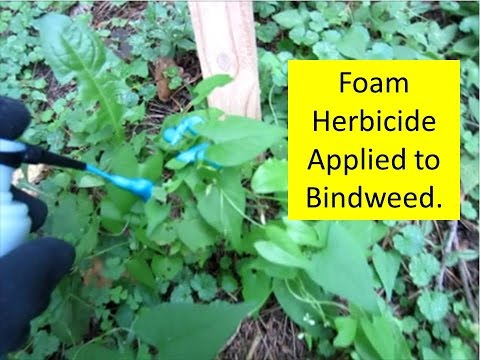
How to kill Morning Glory (Bindweed) with Green Shoots Foam Herbicide
ChannelGreen ShootsDescription from the creator
How to kill bindweed (aka creeping jenny or morningglory) without killing your nearby desirable plants? How to control bindweed so it doesn't re-sprout? For this tough job, use the revolutionary foam herbicide system from Green Shoots: greenshootsonline.com The Green Shoots foam herbicide system has several advantages over conventional spray systems. First, it is highly precise and selective. The foam can be discharged very slowly and placed on the target location. Second, once placed on the target, the foam herbicide sticks to the foliage and tissue of the plant. It doesn’t drip like drops from a conventional spray system. Third, the foam herbicide dries slowly. This increases translocation of the herbicide so that the roots can be killed. Fourth, the foam herbicide is highly concentrated. This ensures that the mixture is sufficiently powerful to do the job. As explained in the video, using the foam herbicide system is easy. The herbicide can be placed directly on foliage – either the green leaves or green stems. Alternatively, if you want to remove the target weed immediately, you can cut it and apply the foam herbicide to the remaining stump. If you do a stump application, be sure to apply the foam herbicide immediately after cutting. Perennial weeds like bindweed have extremely extensive root systems, so be sure to apply the foam herbicide to each stem that you can find. The latin name for bindweed is Convolvulus arvensis.
The Green Shoots Foam Herbicide System creates a foam herbicide that sticks well to plant surfaces. As shown in the video, it works great with the herbicide wiping technique commonly used for foliar applications (i.e., ones to green leaves and stems).
Why use the precision foam herbicide system from Green Shoots to control invasive weeds like field bindweed? The Green Shoots system can help: protect non-target, desirable plants from off-target spray and herbicide drift; save money by cutting back on the amount of herbicide used; and reduce the amount of herbicide introduced into the environment.
Background on the Herbicide Glyphosate
If you use any herbicide, you must read and follow the label provided with it. The herbicide used in this video contains the active ingredient glyphosate. The United States Environmental Protection Agency has commented on glyphosate's "low acute toxicity" and the absence of other toxicological concerns (i.e., carcinogenicity)." It also determined in it's last reregistration decision for glyphosate that "the effects of glyphosate on birds, mammals, fish and invertebrates are minimal." See EPA, Reregistration Eligibility Decision (RED): Glyphosate, February 16, 1994. www.epa.gov/espp/litstatus/effects/glyphosate-red.pdf
Background on Field Bindweed
Field bindweed (Convolvulus arvensis L.) is an invasive weed in much of North America and is identified as a noxious weed in many states. It is an exotic or non-native species brought to North America from Europe or western Asia probably in colonial times.
It is troublesome for agriculture and is common in cultivated field and gardens, along roadsides, railroads, disturbed sites, and abandoned lots. It is often found in moist locations in areas near agricultural fields or on former agricultural sites. Field bindweed has an extensive root system. One plant can reduce available moisture in the top 24 inches of soil below the "wilting point."
Even in urbanized areas, field bindweed can be a pest. It often appears in planting beds, yards, gardens, and lawns.
Other common names include: Field Bindweed, European Bindweed, Creeping Jenny, Smallflowered, Morning Glory, Perennial Morning Glory, Morning Glory, Small Bindweed, Devil's Guts. Additional information can be found at: extension.usu.edu/rangeplants/htm/field-bindwee….
For more tips on dealing with invasive plants, visit Green Shoots News at: greenshootsnews.wordpress.com/wp-admin/.
About this tutorial
Green Shoots published this 1:53 video tutorial on November 12, 2012. It has been watched 23,870 times on YouTube.
- Channel
- Green Shoots
- Category
- Science & Technology
- Duration
- 1:53
- Published
- November 12, 2012
- Views
- 23,870
- Likes
- 46
Tags
Share
This tutorial in other languages
- FRComment tuer Morning Glory (liseron) avec Green Shoots mousse Herbicide
- ESCómo matar a la gloria de mañana (enredadera) con Green brotes de espuma Herbicida
- PTComo matar Morning Glory (trepadeira) com Green Shoots Foam Herbicida
- ITCome uccidere Morning Glory (convolvolo) con Green Shoots Foam erbicida
- DEWie Morning Glory (Bindweed) mit Green Shoots Foam herbizid töten
- NLHoe om te doden Morning Glory (Winde) met Green Shoots Foam Herbicide
- RUКак убить ипомеи (вьюнок) с зелеными побегами пены гербицидом
- PLJak zabić Morning Glory (powój) z zielonym pędy herbicydu Foam
- JAグリーンシュートフォーム除草剤とモーニンググローリー(ヒルガオ)を殺すためにどのように
- ARكيف قتل صباح المجد (اللبلاب) مع الأخضر يطلق النار على رغوة مبيدات الأعشاب
- HIग्रीन शूट्स फोम शाक के साथ मॉर्निंग ग्लोरी (लता) को मारने के लिए कैसे
- IDCara membunuh Morning Glory (bindweed) Green Shoots Foam Herbisida