Playback starts YouTube’s embedded player (privacy-enhanced mode).
How to Use a Sharpening Stone | Knives
ChannelHowcastIn brief
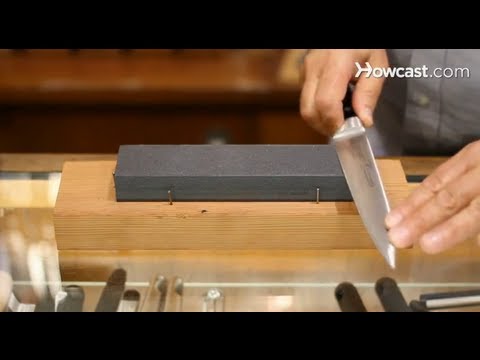
You’ll learn how to sharpen a knife using a sharpening stone, starting with a coarse grit to reshape the blade and moving to a finer grit for a smooth edge. Dan Delavan from Plaza Cutlery demonstrates the technique, including proper angle, pressure, and side-to-side alternation to maintain balance. This method suits anyone looking to maintain or restore their knives’ cutting efficiency.
Questions & answers
What types of stones are mentioned, and how do they differ?
The video covers India stones (harder, require oil) and crystolon stones (coarser, can be used dry). The coarse side removes metal faster but leaves a rougher edge, while the finer side refines it.
How do I know the correct sharpening angle?
Use the ‘butter cube’ guide: angle the blade like slicing off the top of a block of butter to maintain a consistent bevel.
Description from the creator
-
-
Full Playlist: youtube.com/playlist?list=PLLALQuK1NDrifmgcg5ax…
-
-
Watch more What You Need to Know About Knives videos: howcast.com/videos/497077-How-to-Use-a-Sharpeni…
Learn how to use a sharpening stone in this Howcast video with expert Dan Delavan.
Hi. My name is Dan Delavan. I am the Owner/Operator of Plaza Cutlery in Costa Mesa, CA. We have a great selection. We also have a website; plazacutlery.com. Today we are going to be talking about knives.
A sharpening stone is a stone that has got a coarse side and usually a finer side, and that is going to take and re-shape your edge and get it back down thin enough in order to sharpen it. You are basically taking something that is blunt and thinning it back down. You have to remove all of this extra metal and get it back down to where it is thin enough to cut. Very simply, all a knife is is a very thin piece of steel to split whatever you are cutting. If the knife is obviously thicker, it is like trying to cut something with a chisel; it is not going to happen.
There are two stones. There is the India and there is the crystolon. Once you feel them, obviously the difference is coarseness. The one thing about the India stone, it is a harder stone and the brown is the finer side, you have to use oil with it. You cannot use it dry, so therefore it is messy.
The coarse stone will cut the metal off quicker but it is going to give you a rougher edge but that way the job gets done quicker, without the oil. It is not as messy. This is just a real simple set up. If you do wood work you can make a little wooden box and rout it out. In this particular case it is just a 2x4, stone traced out, finishing nails tapped down so they are deeper than the stone so when you drop the stone in, if you are at a workbench you can C-clamp it down in place or you can hold on to it.
So you are going to start at the heel and you are going to time it so that it goes all the way across. You go from one side to the other. You also want to make sure that your stone, I am not going to use as much pressure as I normally would because I cannot mount it on this showcase, you want to alternate from side to side to keep your bevel centered. Some people will take and do three times on one side and then three times on the other, the problem is that your backhand is never as good as your forehand and you end up cheating and you are going to end up with a blade that is offset. That is going to take it and thin down, you are going to get a thin bevel right on the edge. Once you get that V established, you can go from the coarser side to the finer side.
It is the same thing; you want to alternate from one side to the other. Just keep working it until it smooths out. Usually it does not take quite as long on this side because you are just smoothing it out. As you go through the finer stones, if you just choose to do that you are just polishing.
The other question is angle; how do I know what angle to use? It is a real simple guide. If you can imagine this was a big cube of butter and you know how it goes bad? You are just going to filet the top of it off. Again, there are people that do it other ways that work for them great. This is a tried, true simple way of doing it.
About this tutorial
Howcast published this 3:12 video tutorial on October 25, 2012. It has been watched 5,137,048 times on YouTube.
- Channel
- Howcast
- Category
- Howto & Style
- Duration
- 3:12
- Published
- October 25, 2012
- Views
- 5,137,048
- Likes
- 28,835
Tags
Share
Further reading
-
Knife - Wikipedia
en.wikipedia.org
A knife (plural knives; possibly from Old Norse knifr, "knife, dirk") is a tool with a cutting edge or blade often attached to a handle or hilt.One of the earliest tools used by humanity, knives appeared at least two-an…
-
Shop Knives | Amazon.com | Power & Hand Tools - Hand Tools
amazon.com
Online shopping for Tools & Home Improvement from a great selection of Pocket Knives & Folding Knives, Utility Knives, Fixed-Blade Knives, Knife Sets, Knife Blades & more at everyday low prices.
-
Home Page | SMKW
smkw.com
SMKW is your source for Case knives, Buck knives, SOG knives, Victorinox Swiss Army Knives, Microtech, Gerber knives, Kershaw knives, Benchmade knives, Spyderco knives, CRKT knives, Cold Steel Knives, TOPS knives, ESEE…
This tutorial in other languages
- FRComment utiliser une pierre Affûtage | Des couteaux
- ESCómo utilizar una piedra de afilar | cuchillos
- PTComo usar uma pedra de amolar | Facas
- ITCome utilizzare una pietra per affilare | Coltelli
- DEWie ein Schleifstein verwenden | Messer
- NLHoe maak je een slijpsteen gebruiken | messen
- RUКак использовать точило | Ножи
- PLJak korzystać z Osełka | noże
- JA砥石を使用する方法|ナイフ
- ARكيفية استخدام حجر شحذ | سكاكين
- HIकैसे एक तेज़ करने स्टोन का उपयोग करने के लिए | चाकू
- IDCara menggunakan Sharpening Batu | pisau